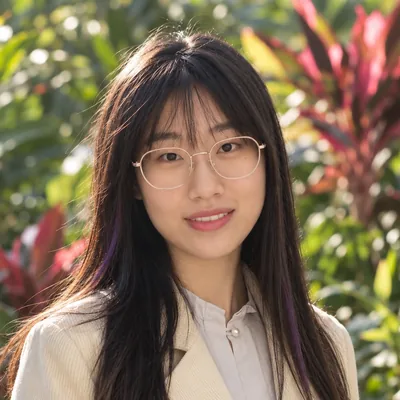
Portrait of Zhiwei (Vivi) Li

Zhiwei (Vivi) Li

I am a Ph.D. candidate in Industrial & Systems Engineering at the University of Southern California, working with Carl Kesselman (opens in a new tab) at the Information Sciences Institute.

My research focuses on making it easier for researchers with different expertise to collaborate. I explore how AI and research tools can bridge gaps in understanding, so that ideas and insights from one field can become useful in another. My broader aim is to turn individual expertise into shared scientific progress.

My research brings together scientific ML infrastructure, organizational learning, and human–computer interaction. I study how interdisciplinary teams share and retain knowledge, and how AI agents can support communication and collaboration across people and research sessions. I also design research software that connects data, experiments, and their context to support reliable, reproducible science, with healthcare as a central application setting.

I also pursue related work in applied machine learning and medical image analysis.


Research

Selected projects

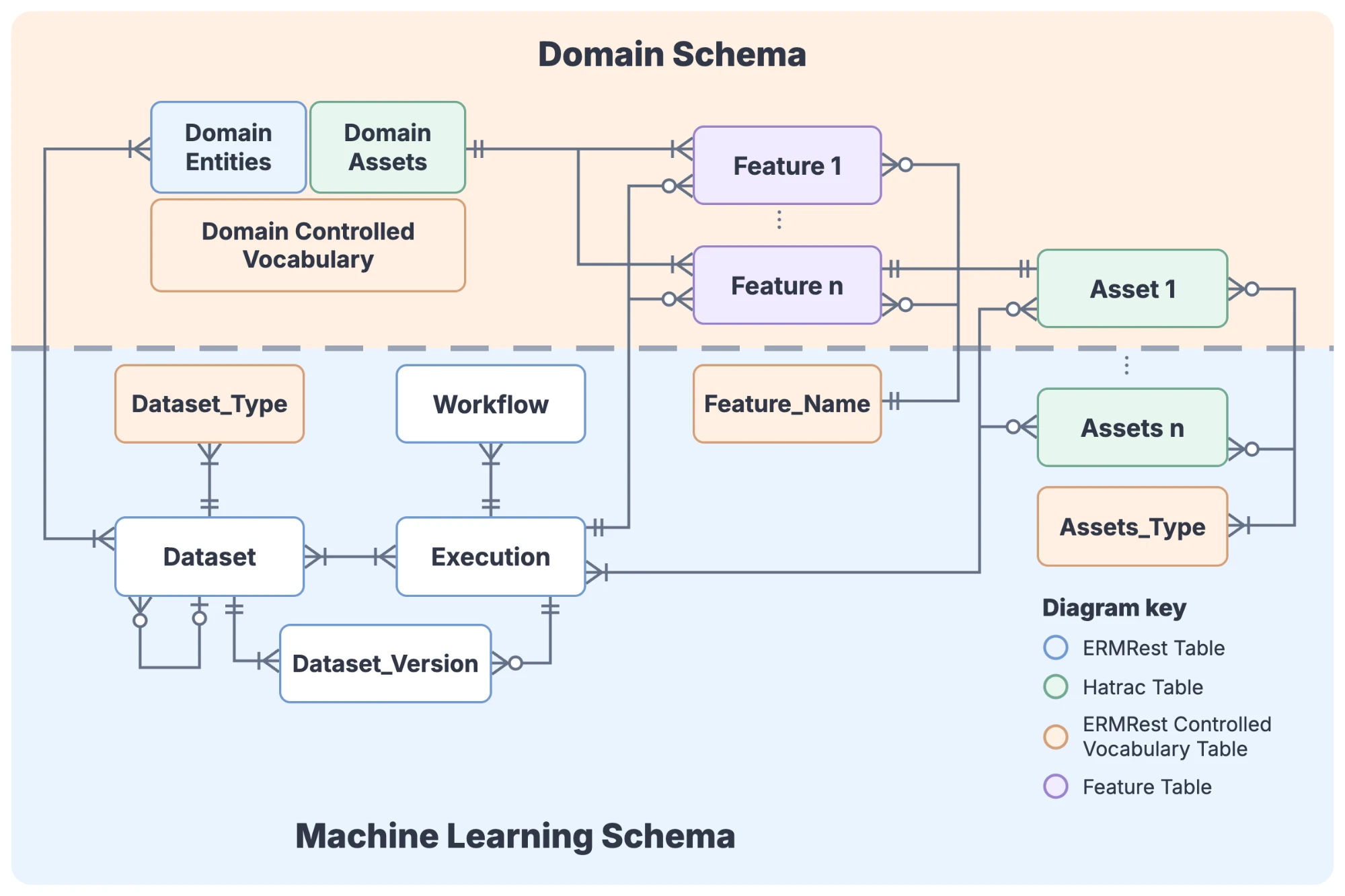
Entity–relationship diagram of the Deriva-ML data model: a domain schema (domain entities, domain assets, domain controlled vocabulary, and feature tables) linked to a machine learning schema (Dataset, Dataset_Type, Dataset_Version, Workflow, Execution, Feature_Name, and asset tables).

Deriva-ML

Data-Centric Infrastructure for Reproducible Machine Learning

Deriva-ML provides a domain-independent foundation for reproducible machine learning, managing datasets, features, workflows, executions, and their provenance. I designed its initial architecture and ML data model and implemented the first Python library prototype, connecting research artifacts with the processes that produced them. Subsequent production development and maintenance have been collaborative team efforts.

Code is the shared Deriva-ML team repository.
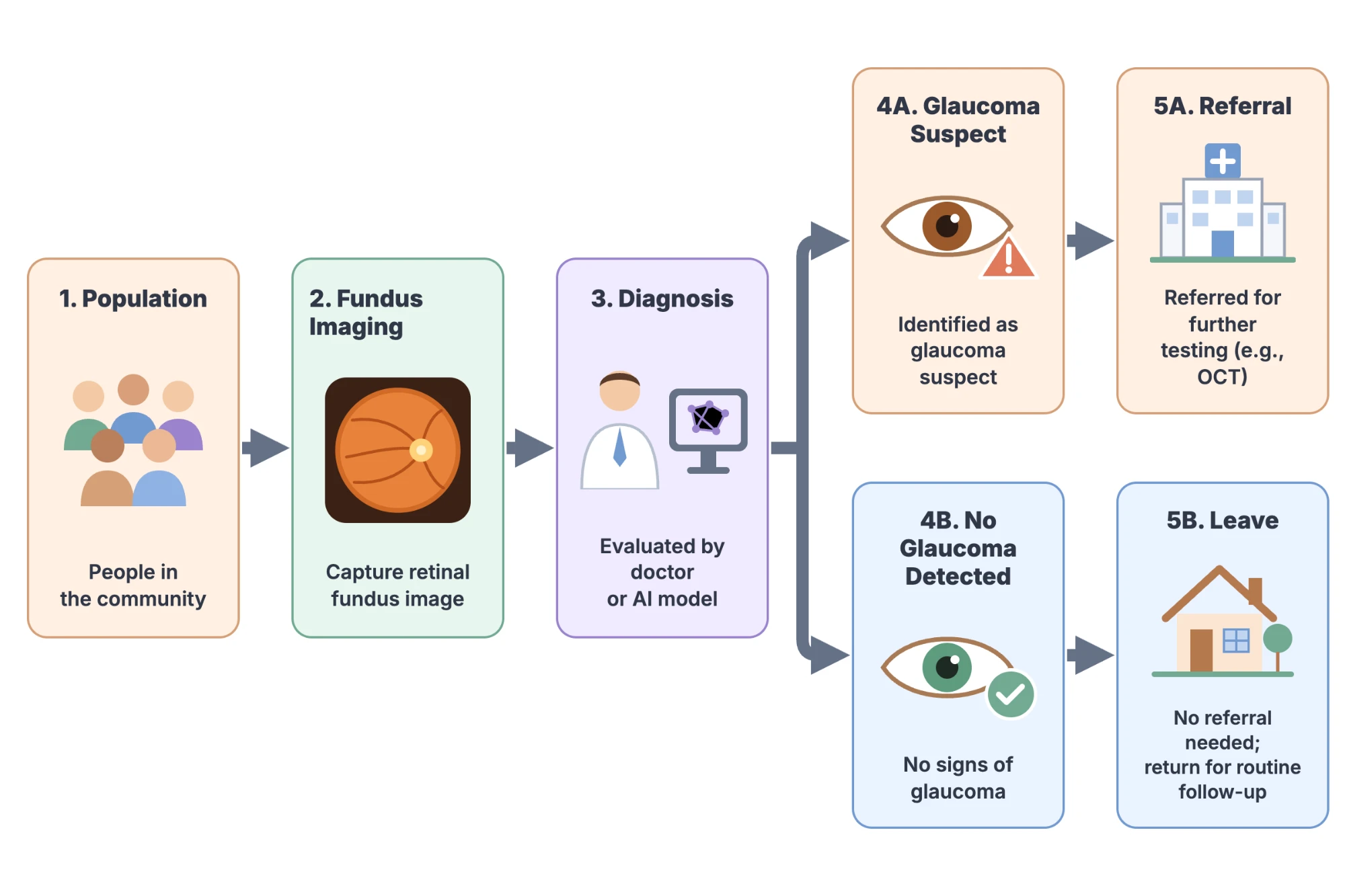
Screening workflow for glaucoma: people in the community have retinal fundus images captured, which are evaluated by a doctor or AI model; glaucoma suspects are referred for further testing (e.g., OCT), and people with no signs of glaucoma return for routine follow-up.

EyeAI

Clinical ML Workflows and System Integration

EyeAI is an interdisciplinary glaucoma research project that informed and uses Deriva-ML. I designed and implemented EyeAI-specific Python methods for ophthalmic image analytics, clinical labeling, and multimodal dataset preparation. I also created reusable experiment notebooks and documentation, onboarded researchers, and served as the primary end-to-end workflow validator across Deriva, Deriva-ML, and EyeAI revisions.

Code is the shared EyeAI team repository.

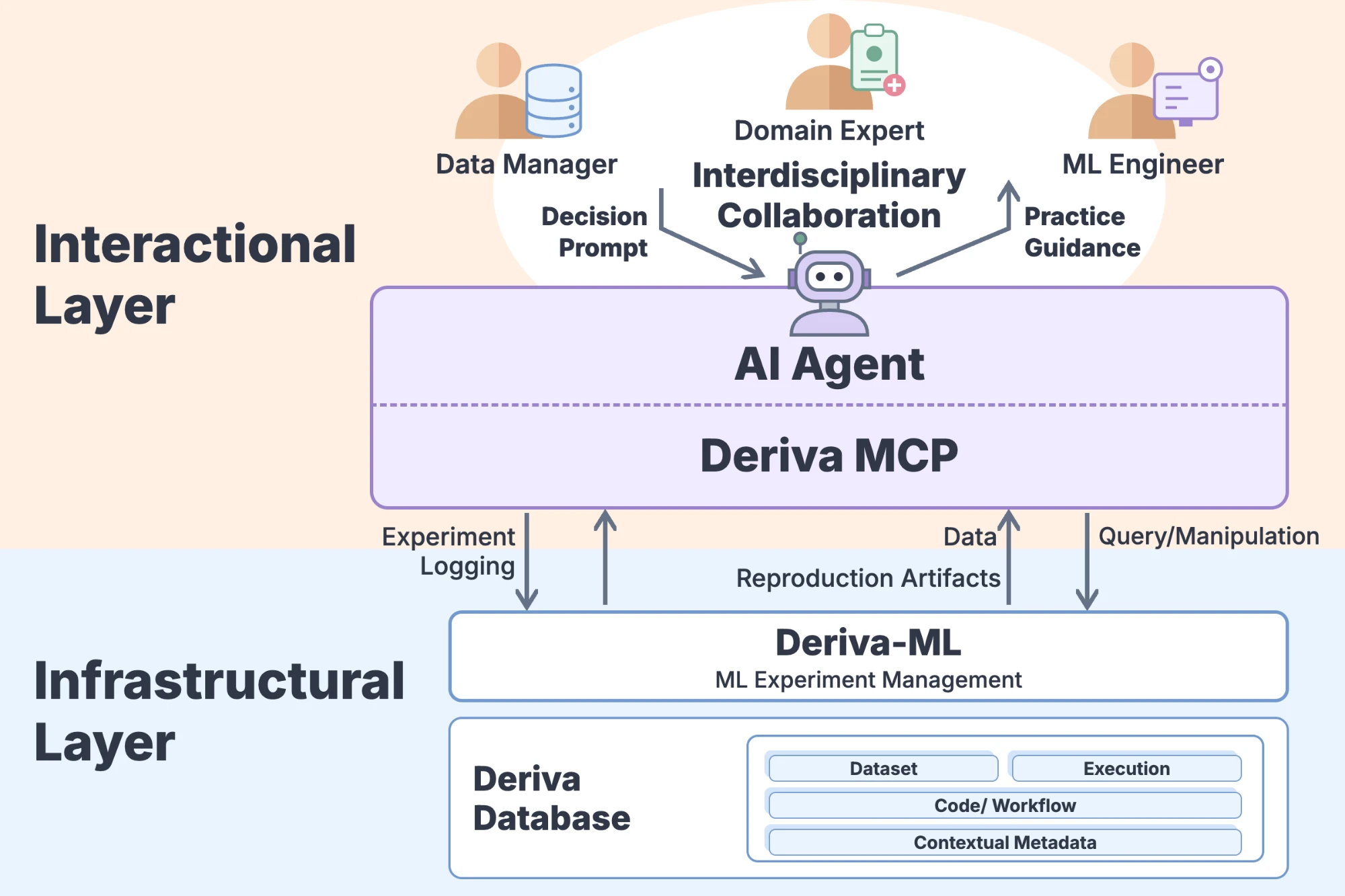
Diagram of agent-mediated research: in an interactional layer, an AI agent working through Deriva MCP connects a data manager, a domain expert, and an ML engineer; below it, an infrastructural layer of Deriva-ML and the Deriva database holds datasets, executions, code and workflows, and contextual metadata.

Agent-Mediated Scientific Research

Evaluating Discovery Interfaces and AI Agents for Science

I investigate how AI agents interact with structured scientific repositories to support data discovery and research workflows. I designed and conducted a comparative study with five domain researchers, comparing faceted search, a repository chatbot, and an unconnected LLM. I also analyzed 39 data-discovery prompts to the team-developed agent, with their tool-mediated interactions and failure modes, to identify capabilities and limitations of agent-supported research.

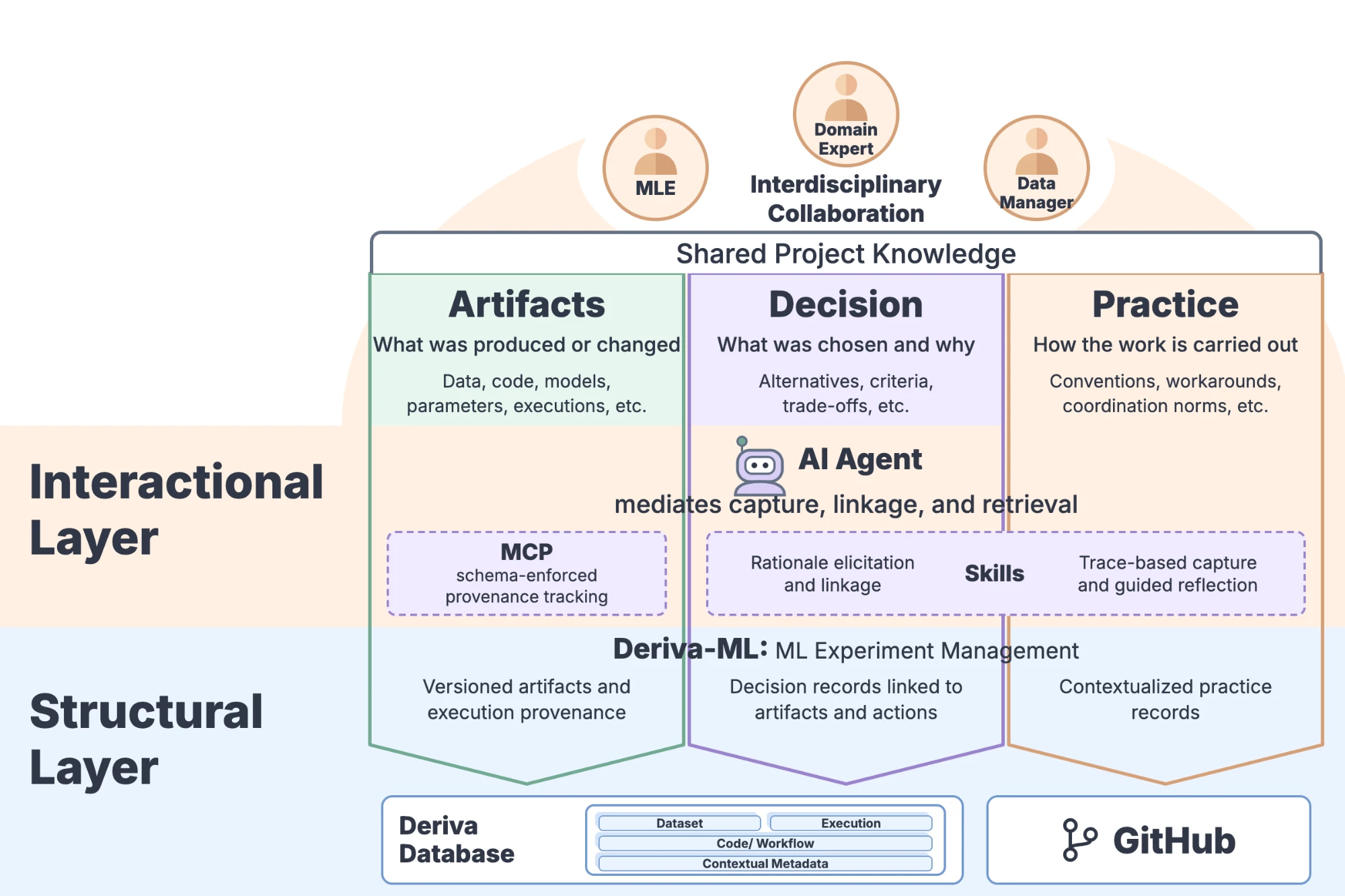
Diagram of shared project knowledge in interdisciplinary collaboration: artifacts (what was produced or changed), decisions (what was chosen and why), and practice (how the work is carried out), captured and linked by an AI agent and stored in Deriva-ML, the Deriva database, and GitHub.

Knowledge Transfer in Collaborative Science

How Context and Reasoning Move Across Collaborators and Sessions

Scientific collaboration depends on decisions, rationale, and working practices as well as data and computational artifacts. Through a longitudinal, abductive case study of interdisciplinary ML collaboration, I identified 12 knowledge-transfer trajectories and five recurring breakdown types. I also analyzed a 44-day, 113-entry rationale record to examine how contextual knowledge persists across collaborators and research sessions. This work informs my ongoing research on capturing and retrieving scientific knowledge.

Additional projects

  • Course research project · sole-author report

    Decision-focused learning for glaucoma referral scheduling

    Connecting glaucoma severity prediction to referral scheduling under operational constraints.

  • ISE 610 · May 2025 · Sole-author report

    Glaucoma severity labels and clinical measurements

    Compared clinician-assigned ICD severity labels with computable labels derived from visual-field criteria, using weighted kappa with bootstrap uncertainty, ordinal regression, elastic net, and XGBoost.

    Recovery of the label-defining rules is not presented as independent clinical prediction.

  • ISE 662 · Sole-author report

    AI and clinician decision performance in glaucoma diagnosis

    Used signal detection theory to separate discriminability from response bias in a retrospective comparison involving 1,000 images and 13 graders, with analysis by image quality and demographic subgroup.

    The one-grader-per-image workflow was simulated.

  • ISE 633 · December 2025

    Data ordering effects in medical image classification

    A 150-run factorial study of VGG-19 training on 11,108 fundus images, comparing five ordering strategies, two optimizers, and 15 replications per condition. Label-first ordering performed near chance; image-quality orderings showed no statistically significant advantage over random ordering.

    Joint project with Rhea Huang.


2026

2025

2024

2020


Teaching & Recognition

Teaching

Teaching Assistant, University of Southern California

  • ISE 529 — Predictive Analytics Fall 2022
  • ISE 558 — Data Management for Analytics Fall 2024 and Spring 2025

Recognition

  • Jenny Wang Excellence in Teaching Award USC Viterbi School of Engineering2025
  • Teaching Assistant of the Year USC Epstein Department of Industrial & Systems Engineering2025
  • Research Fellowship USC Epstein Department of Industrial & Systems Engineering2023